

How to Store TMT Bars at Construction Sites in Gujarat: A Practical Guide
September 8, 2026
July 16, 2026
India's infrastructure sector continues to be one of the country's strongest growth drivers. Investments in highways, railways, metro systems, ports, airports, industrial corridors, logistics parks, renewable energy projects, and urban development are creating sustained demand for construction materials across the country.
For the steel industry, this growth represents more than increased consumption. It is changing what developers, contractors, and infrastructure companies expect from steel manufacturers.
Today, projects require not only dependable material supply but also manufacturing consistency, value-added processing, sustainability, and technical reliability.
Government investments in transport, energy, industrial development, and urban infrastructure continue to generate demand for reinforcement steel across a wide range of projects.
Large-scale developments require manufacturers that can consistently supply reinforcement products while meeting project schedules and quality expectations.
As infrastructure expands, steel manufacturers play an increasingly important role in supporting project execution.
Construction projects have become more complex than ever before.
Developers increasingly look for manufacturers that can provide:
The focus has shifted from simply purchasing steel to partnering with manufacturers that can contribute to efficient project delivery.
Factory-processed reinforcement is increasingly being adopted across infrastructure and industrial projects.
Solutions such as Cut & Bend Solutions help improve reinforcement planning, reduce on-site processing, and support faster construction workflows.
Similarly, projects exposed to challenging environmental conditions may specify products such as CRS Green Steel or Epoxy Coated TMT Bars depending on engineering requirements.
Infrastructure growth is increasingly accompanied by greater emphasis on sustainability.
Manufacturers are investing in renewable energy, responsible water management, Waste Heat Recovery Systems, and resource-efficient production processes to support long-term environmental goals while maintaining operational performance.
These initiatives are becoming an important part of how manufacturers differentiate themselves in a competitive market.
With manufacturing operations in Kutch and Samakhiyali, Gujarat, and its corporate headquarters in Ahmedabad, German Steel continues to support infrastructure, industrial, and commercial projects through an integrated manufacturing ecosystem.
The company manufactures TMT Bars, CRS Green Steel, Epoxy Coated TMT Bars, and advanced Cut & Bend Solutions while investing in renewable energy, Waste Heat Recovery Systems, dedicated water reserves, and modern manufacturing infrastructure.
India's infrastructure pipeline is expected to remain one of the strongest drivers of steel demand in the coming years.
Manufacturers that combine quality products, sustainable operations, advanced processing capabilities, and dependable supply will continue to play a vital role in supporting the country's next phase of development.
Infrastructure projects require large volumes of reinforcement steel for roads, bridges, buildings, industrial facilities, and public infrastructure, making them a major source of steel demand.
Solutions such as Cut & Bend processing improve reinforcement accuracy, reduce on-site work, and help streamline project execution.
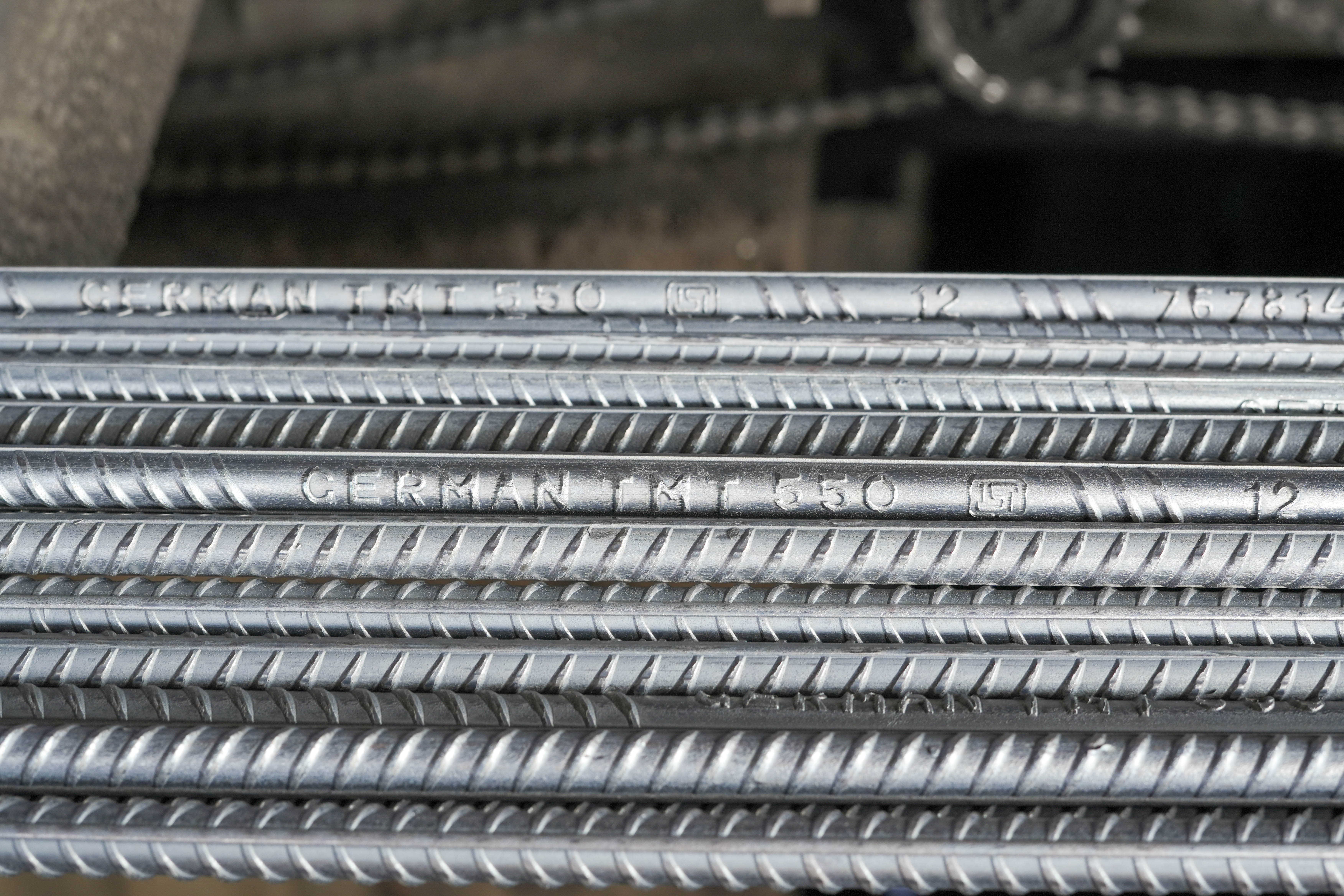
German Steel manufactures TMT Bars, CRS Green Steel, Epoxy Coated TMT Bars, and advanced Cut & Bend Solutions for infrastructure, industrial, and commercial construction.
[ Where we share insights, updates, and stories that matter in the world of construction and beyond. ]
Learn how to store TMT bars correctly at construction sites in Gujarat. Explore practical TMT storage, handling and reinforcement management practices for contractors.

Learn how to select TMT bars for high-rise buildings based on strength, ductility, bendability, bonding, corrosion resistance and project requirements.

.jpg)


.webp)