

How to Store TMT Bars at Construction Sites in Gujarat: A Practical Guide
September 8, 2026
August 21, 2026
When purchasing TMT bars for a construction project, checking the brand and quoted price is only the beginning.
Contractors and procurement teams also need to ensure that the reinforcement delivered to the site matches the required diameter, grade, quantity and specifications.
For projects in Ahmedabad and across Gujarat, this becomes particularly important when large quantities of steel are being purchased for residential, commercial, industrial or infrastructure construction.
Knowing how to check TMT bar weight and diameter gives project teams another practical way to verify what they have received.
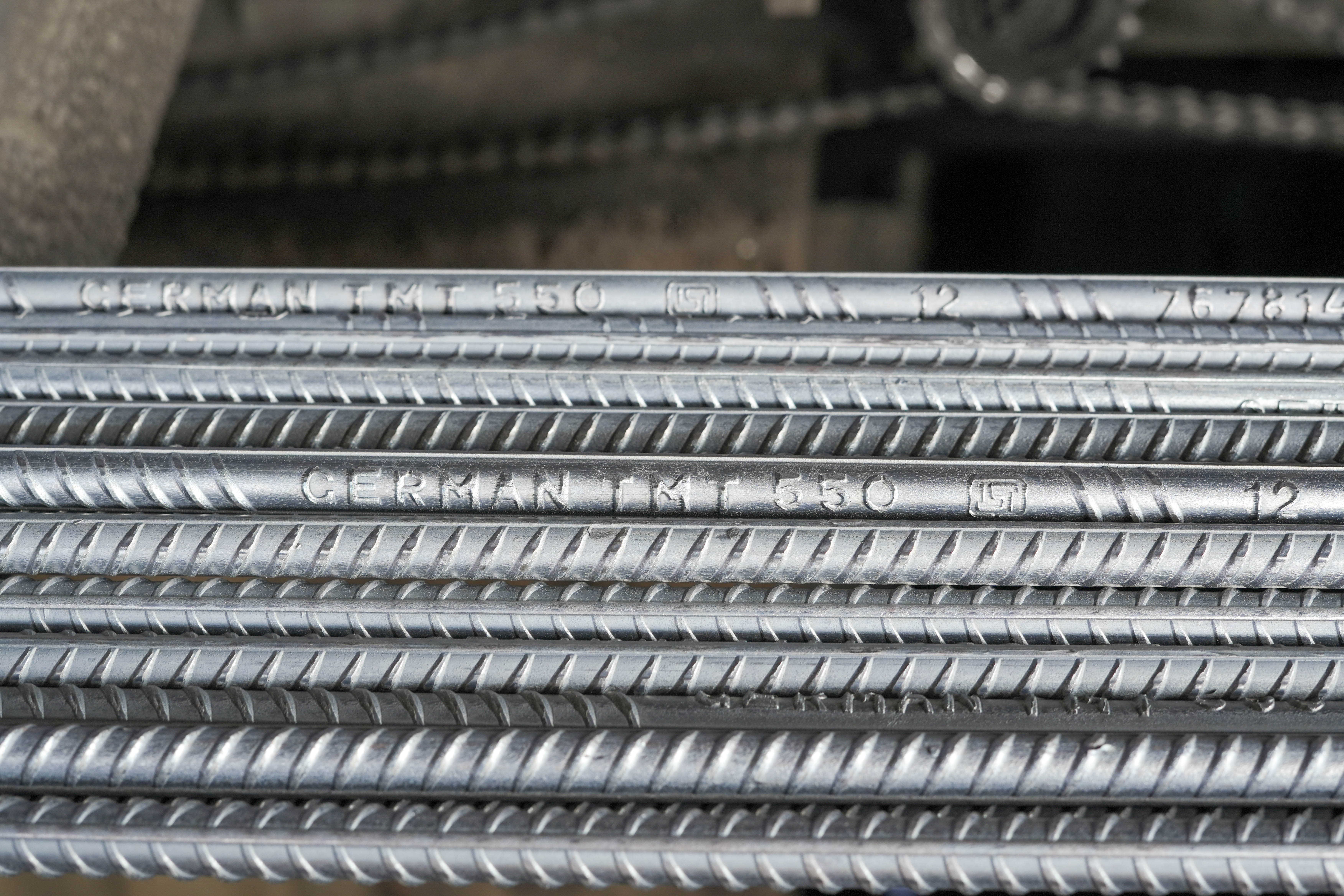
German Steel manufactures TMT Bars for a wide range of construction applications, with manufacturing operations in Gujarat.
TMT reinforcement is commonly purchased and supplied by weight, while structural drawings specify reinforcement according to bar diameter, spacing, length and quantity.
This means procurement teams need to understand the relationship between bar diameter, length and theoretical weight.
For example, larger-diameter bars naturally weigh more per metre than smaller-diameter bars.
A difference between the expected and actual quantity received can therefore affect the project's material reconciliation and procurement calculations.
The theoretical weight of a round steel bar can be estimated using:
Weight per metre ≈ D² / 162
where D is the nominal diameter of the bar in millimetres.
For example:
These are theoretical values based on nominal diameter and should not be treated as a substitute for the applicable product specification or project documentation.
Diameter verification can be part of the incoming-material inspection process.
A contractor or quality-control team can use appropriate measuring equipment to check the dimensions of sample bars received at the site.
However, TMT bars have ribs along their surface, so measurement needs to be performed correctly. Simply measuring the outermost rib dimension and treating it as the nominal steel diameter can lead to an inaccurate interpretation.
For formal acceptance, project teams should follow the relevant standards, testing procedures and project specifications.
A TMT bar is not simply a smooth round steel rod.
Its surface ribs are designed to provide mechanical interaction with concrete.
This makes consistency in bar geometry important for reinforcement performance.
However, diameter alone does not determine whether a TMT bar is suitable. Buyers should also consider the required grade, mechanical properties, applicable standards and quality documentation.
German Steel's TMT Bars are manufactured for reinforced concrete applications with controlled production processes.
For a practical site-level verification, project teams can select representative bars from a delivery and record:
The measured quantity can then be compared with the expected quantity and the relevant product specifications.
For large procurement orders, the process should be documented as part of the project's material-receiving procedure.
One important point is that weight is not a complete test of TMT quality.
A bar should not be accepted or rejected solely because of a simple site weight calculation.
Mechanical properties, chemical composition, dimensional characteristics, bend performance and other specified parameters may also need to be verified according to the applicable standards and project requirements.
German Steel already covers the broader subject in How Is Steel Quality Tested Before It Reaches a Construction Site?.
The two checks therefore serve different purposes:
Weight and diameter checks → practical incoming-material verification.
Laboratory and quality testing → verification of specified material properties.
A systematic receiving process can help prevent procurement mistakes.
Before accepting a delivery, project teams can verify:
The exact inspection requirements should be established by the project's quality-control system and technical specifications.
Site-level checks are useful, but reliable reinforcement starts with consistent manufacturing.
If every incoming batch needs to be treated as an unknown quantity, procurement and quality teams have a much greater verification burden.
A manufacturer with established production and quality-control systems can provide greater confidence in consistency across deliveries.
German Steel's manufacturing operations in Gujarat support its TMT reinforcement production, while its wider portfolio includes MS Billets and Sponge Iron.
This broader manufacturing ecosystem is part of the company's approach to steel production.
For a small construction project, a difference in a few individual bars may appear insignificant.
For large residential developments, commercial projects and infrastructure construction, however, reinforcement can involve hundreds or thousands of tonnes of material.
Small discrepancies can therefore become significant when multiplied across large volumes.
This is why structured material reconciliation is important for professional construction procurement.
When reinforcement is supplied after factory cutting and bending, contractors need to consider more than straight-bar weight and diameter.
The reinforcement should also be checked against:
German Steel provides Cut & Bend Solutions for projects requiring reinforcement to be processed according to specified requirements.
This can move part of the reinforcement preparation process away from the construction site and into a controlled manufacturing environment.
Before accepting a TMT delivery, ask:
Is the grade correct?
Is the nominal diameter correct?
Does the quantity match the order?
Is the material properly identified and documented?
Does the physical condition meet the project requirements?
Are the required quality documents available?
Does the delivered reinforcement match the project specification?
These checks can help identify discrepancies before the steel moves deeper into the construction process.
Gujarat's construction market includes residential developments, commercial buildings, industrial facilities and major infrastructure projects.
Each project can have different reinforcement requirements, but all depend on receiving steel that matches the specified material.
German Steel manufactures TMT Bars as part of its Gujarat-based steel manufacturing ecosystem.
For specialised requirements, its portfolio also includes Epoxy Coated TMT Bars, CRS Green Steel and Cut & Bend Solutions.
For contractors, the objective should always be the same: verify the material received, maintain proper documentation and ensure the reinforcement matches the project's technical requirements.
Checking TMT bar weight and diameter is a useful part of construction material verification, particularly when large quantities of reinforcement are being procured.
But these checks should be considered alongside grade, mechanical properties, quality documentation and applicable standards.
For Gujarat contractors and procurement teams, choosing a manufacturer with established production and quality systems can make the entire reinforcement procurement process more reliable.
With German Steel TMT Bars, project teams have access to reinforcement manufactured within Gujarat and supported by a broader portfolio of steel and value-added reinforcement solutions.
A commonly used theoretical formula is D²/162, where D is the nominal bar diameter in millimetres. The result gives an approximate weight per metre in kilograms.
A 12 mm TMT bar has a theoretical weight of approximately 0.889 kg per metre.
Diameter can be checked using suitable measuring equipment and an appropriate measurement procedure. Because TMT bars have ribs, the measurement should be interpreted according to the applicable specification rather than simply measuring the largest external dimension.
No. Weight is only one practical verification point. TMT quality also involves mechanical properties, chemical composition, dimensional characteristics, testing and compliance with applicable requirements.
Contractors should verify the specified grade, diameter, quantity, manufacturer information, physical condition, required documentation and compliance with project specifications.
German Steel manufactures TMT Bars for construction and infrastructure applications, with its manufacturing operations based in Gujarat.
[ Where we share insights, updates, and stories that matter in the world of construction and beyond. ]
Learn how to store TMT bars correctly at construction sites in Gujarat. Explore practical TMT storage, handling and reinforcement management practices for contractors.

Learn how to select TMT bars for high-rise buildings based on strength, ductility, bendability, bonding, corrosion resistance and project requirements.


.jpg)


.webp)