


How to Store TMT Bars at Construction Sites in Gujarat: A Practical Guide
September 8, 2026
August 21, 2026
A construction project can have the right drawings, the right contractor and the right TMT grade—and still end up with a mismatch between the TMT steel ordered, delivered, processed and actually consumed.
For contractors and developers in Ahmedabad and across Gujarat, this can become an expensive problem when reinforcement requirements run into hundreds of tonnes.
A shortage can interrupt construction.
An excess can tie up working capital and increase storage and handling requirements.
And unexplained differences between estimated and actual consumption can make project costing more difficult.
The solution is not simply to order more steel.
It is to create better control over the reinforcement journey—from planning and manufacturing to delivery, processing and installation.
This is where working with a capable manufacturer such as German Steel can add value.
German Steel manufactures TMT Bars and also offers Cut & Bend Solutions, giving construction teams options for managing reinforcement more systematically.
TMT quantity differences can arise from several stages of construction.
Common causes include:
The earlier these issues are identified, the easier they are to control.
One of the first sources of mismatch is procurement planning.
If steel is ordered without sufficiently detailed reinforcement schedules, the project may eventually require different quantities or diameters from what was originally expected.
A better approach is to connect procurement with:
Structural drawings → Bar Bending Schedule → Required quantities → Delivery schedule → Site consumption
This creates a clearer link between what the project needs and what is actually purchased.
German Steel's existing article on Why Reinforcement Planning Starts Long Before Construction Begins explores this planning approach in greater detail.
When reinforcement is processed manually at a construction site, straight bars have to be measured, cut and bent according to the required shapes.
Poor optimisation can result in offcuts that are difficult to reuse.
Even when individual losses appear small, they can become significant when repeated across a large project.
German Steel's Cut & Bend Solutions allow reinforcement to be processed according to project requirements before it reaches the construction site.
Instead of bringing all straight reinforcement to the site and carrying out the entire processing operation there, project teams can receive reinforcement prepared according to specified shapes and dimensions.
This can help improve:
The company's existing article Can Cut & Bend Services Reduce Material Wastage on Construction Sites? covers the wastage aspect in more detail.
Construction teams sometimes maintain additional quantities as a buffer against shortages.
Some buffer can be practical, but excessive over-ordering can create its own problems.
Large quantities of unused reinforcement mean:
A better strategy is to divide procurement into planned project stages wherever the project schedule and supplier capabilities allow.
Large construction projects rarely consume all their reinforcement in one operation.
Steel may arrive through multiple deliveries corresponding to different construction stages.
If incoming quantities, processed quantities and installed quantities are not properly recorded, the project team can lose visibility over actual consumption.
A structured system should track:
Ordered quantity → Delivered quantity → Processed quantity → Issued quantity → Installed quantity → Balance
This makes it easier to identify discrepancies before they become major procurement problems.
Incorrectly cut or bent reinforcement may have to be reprocessed.
That can mean additional steel consumption, labour, handling and time.
For projects with complex reinforcement schedules, shifting processing into a controlled manufacturing environment can reduce some of the variables associated with manual site processing.
German Steel's Cut & Bend Solutions are designed for projects where reinforcement needs to be prepared according to specified requirements.
TMT quantity management is not only a contractor problem.
The steel manufacturer and supplier are also part of the project's material chain.
A reliable manufacturing partner can support project teams through:
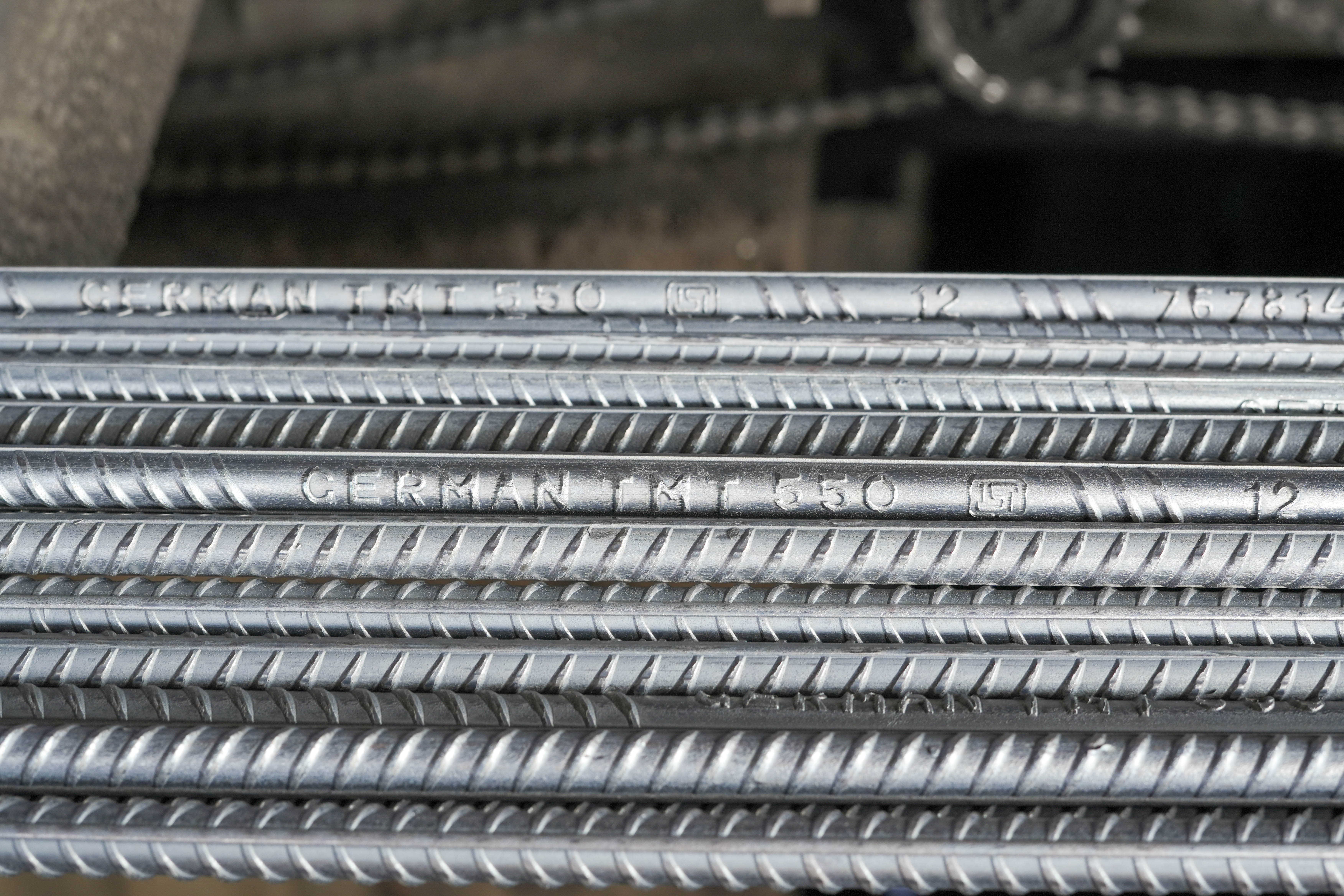
German Steel's TMT Bars form the core of its reinforcement portfolio, while its Cut & Bend capability allows projects to procure reinforcement in a more construction-ready format.
Different projects can have different reinforcement requirements.
German Steel's portfolio extends beyond conventional TMT reinforcement.
For projects where additional corrosion protection is specified, German Epoxy Coated TMT Bars provide an additional protective coating.
For projects where corrosion resistance and sustainability are important considerations, CRS Green Steel is another specialised option.
This means project teams can evaluate reinforcement according to the actual requirements of the structure instead of treating every project as a standard TMT application.
Gujarat's construction market includes everything from residential and commercial developments to industrial facilities and major infrastructure.
As project sizes increase, reinforcement procurement becomes increasingly important to project cost and execution.
A manufacturer with a broad product portfolio and Gujarat-based manufacturing capabilities can become more than a steel vendor—it can become part of the project's reinforcement planning and supply process.
German Steel's manufacturing presence in Gujarat, combined with its TMT and value-added reinforcement solutions, positions the company to support these different construction requirements.
Contractors can reduce quantity mismatches by following a simple process:
Use approved structural drawings and reinforcement schedules as the basis for procurement.
Align deliveries with the construction programme wherever practical.
Record incoming quantities and reconcile them against purchase orders and project requirements.
Optimise reinforcement processing and consider factory Cut & Bend where it makes sense for the project.
Compare theoretical requirements against actual steel issued and installed.
A manufacturer that can supply TMT consistently and provide value-added processing can simplify reinforcement procurement for larger projects.
TMT steel is one of the largest material inputs in many reinforced concrete projects.
That makes every stage—from estimating and ordering to cutting, bending, delivery and installation—important.
For Gujarat contractors, choosing German Steel TMT Bars provides access to a dedicated reinforcement product, while German Steel Cut & Bend can help move reinforcement preparation into a more controlled manufacturing process.
The objective is simple:
Order what the project needs. Process it accurately. Deliver it when required. Track what is consumed.
Better reinforcement control can mean less uncertainty, less rework and a more predictable construction process.
Differences can result from drawing changes, cutting requirements, processing losses, rework, incorrect estimation, site handling and inventory-control issues.
Factory Cut & Bend can improve control over reinforcement dimensions and processing. Its suitability depends on the project's drawings, reinforcement schedules and execution requirements.
Tracking ordered, delivered, processed and installed quantities helps contractors identify discrepancies early and maintain better control over project costs.
Yes. German Steel offers Cut & Bend Solutions as part of its reinforcement portfolio.
German Steel offers TMT Bars, Epoxy Coated TMT Bars, CRS Green Steel, and Cut & Bend Solutions.
[ Where we share insights, updates, and stories that matter in the world of construction and beyond. ]
Learn how to store TMT bars correctly at construction sites in Gujarat. Explore practical TMT storage, handling and reinforcement management practices for contractors.

Learn how to select TMT bars for high-rise buildings based on strength, ductility, bendability, bonding, corrosion resistance and project requirements.


.jpg)


.webp)