

How to Store TMT Bars at Construction Sites in Gujarat: A Practical Guide
September 8, 2026
September 8, 2026
When a construction project requires hundreds or thousands of tonnes of reinforcement steel, selecting a TMT bar is not simply about choosing the required grade. The consistency of that steel across production batches can be equally important.
A large residential development, industrial facility, commercial project or infrastructure development may receive TMT bars through multiple deliveries over an extended construction schedule. Engineers and contractors therefore need confidence that the reinforcement supplied throughout the project maintains consistent dimensional, mechanical and processing characteristics.
This is where the manufacturing discipline behind TMT bars becomes important.
For projects that depend on predictable reinforcement performance, German TMT combines controlled steel manufacturing, integrated production capabilities and advanced thermo-mechanical processing to deliver reinforcement designed for demanding construction requirements.
TMT bar quality consistency means that different production batches of the same specified product continue to meet the required technical characteristics.
For construction teams, this can involve consistency in areas such as:
A TMT bar is ultimately part of a larger structural system. Consistency gives engineers and contractors greater confidence that the reinforcement being received remains aligned with the project's specified requirements.
You can explore German Steel's range of TMT Bars to understand the reinforcement products manufactured for different construction applications.
A small residential project may require a comparatively limited quantity of reinforcement steel. Large construction projects operate at a completely different scale.
A project can involve:
This makes consistency particularly important.
If reinforcement characteristics vary significantly between batches, project teams may need additional verification, coordination or adjustments during procurement and execution.
Consistent material, on the other hand, makes reinforcement planning and execution more predictable.
Mechanical properties are among the most important characteristics engineers consider when specifying reinforcement steel.
Yield strength indicates the stress level at which the steel begins to undergo significant plastic deformation, while tensile strength indicates the maximum stress the material can withstand before failure.
Elongation provides an indication of the material's ability to deform before fracture.
For structural reinforcement, these characteristics work together rather than independently.
That is why selecting a TMT bar should not be based solely on the highest numerical strength. The reinforcement should provide the combination of strength, ductility and workability required by the structural design.
German Steel's existing guide on strength, ductility and weldability in modern TMT bars provides further context on these interconnected properties.
Quality consistency is not limited to mechanical performance.
Dimensional consistency also matters during reinforcement fabrication and installation.
TMT bars are ordered, processed and placed according to structural drawings and reinforcement schedules. Variations in dimensions or weight characteristics can create complications when large quantities of reinforcement are being processed.
For contractors, consistent material helps support:
These advantages become increasingly valuable as project size increases.
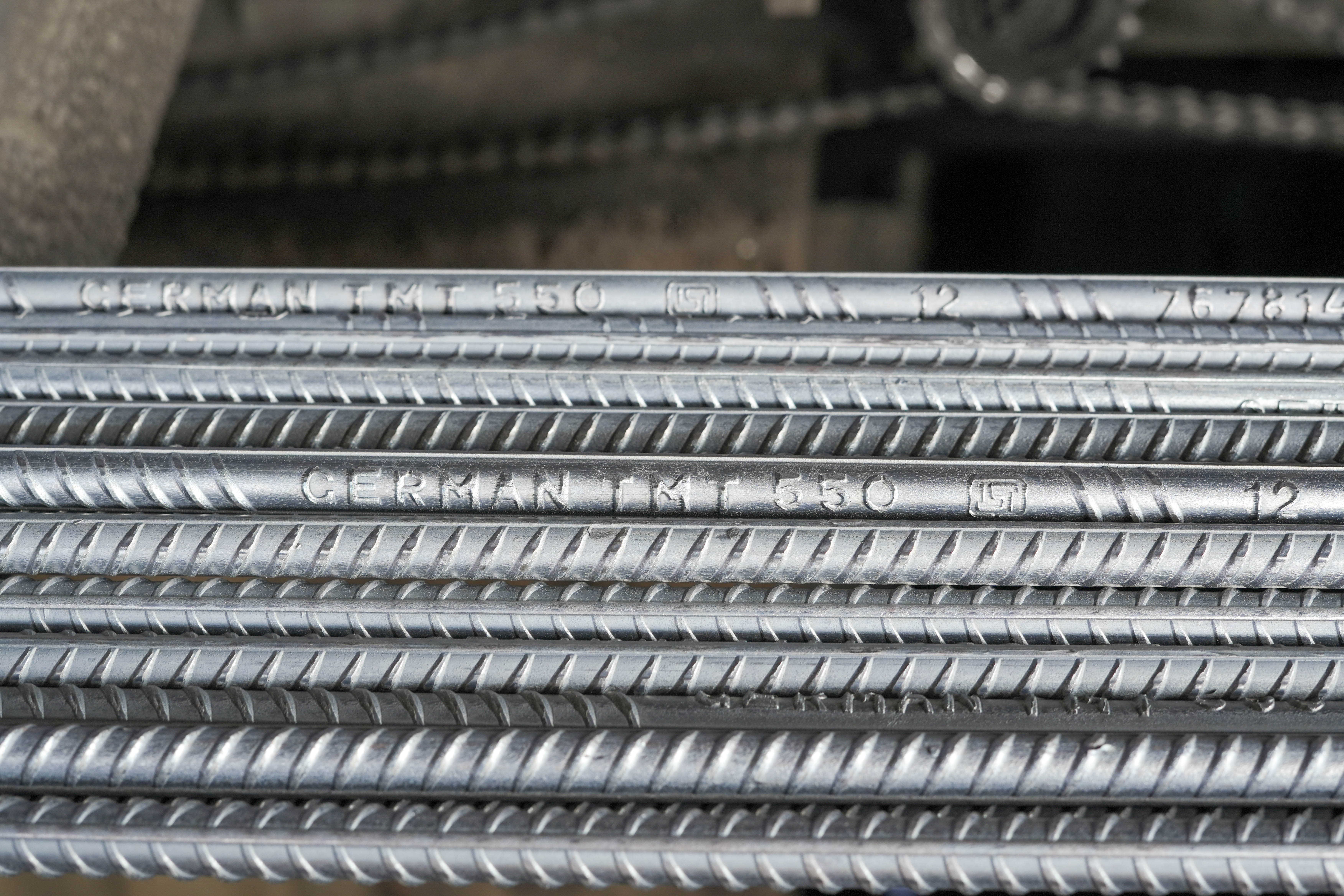
TMT bars are designed with surface ribs that improve mechanical interaction with surrounding concrete.
The geometry and consistency of the bar surface therefore form an important part of reinforcement performance.
During construction, reinforcement must work together with concrete as a composite structural system. The interaction between the steel surface and concrete contributes to anchorage and load transfer within reinforced concrete members.
Consistent surface characteristics help ensure that reinforcement behaves predictably across different batches and applications.
The quality of a finished TMT bar is influenced by the manufacturing stages that come before it.
The steelmaking process, billet production, reheating, rolling and thermo-mechanical treatment all contribute to the characteristics of the finished reinforcement.
German Steel's integrated manufacturing ecosystem includes MS Billets as part of its broader steel production portfolio.
Controlling important stages of production can help manufacturers maintain greater consistency in the material moving through subsequent processing stages.
This is one reason the manufacturing process behind reinforcement steel deserves as much attention as the final product specification.
Billets are an important intermediate product in the production of long steel products.
Their chemical and metallurgical characteristics influence the subsequent rolling process and ultimately contribute to the properties of the finished TMT bar.
For a manufacturer, maintaining control over the upstream stages of production can create a stronger foundation for consistent downstream output.
German Steel's integrated production capabilities connect different stages of its steel manufacturing ecosystem, supporting greater control over the journey from raw material and intermediate steel products to finished reinforcement.
The defining characteristic of TMT reinforcement is the controlled combination of mechanical deformation and thermal treatment.
During TMT production, the bar undergoes controlled cooling and subsequent self-tempering processes that help establish the desired combination of strength and ductility.
German TMT uses Thermex Quenching Technology as part of its TMT manufacturing process.
The objective is not simply to produce a strong outer surface. The manufacturing process is designed to achieve the required combination of strength and ductility throughout the bar.
For engineers and contractors, this controlled processing is an important part of understanding why manufacturing technology influences finished reinforcement performance.
Contractors are responsible for converting structural drawings into physical reinforcement on site.
That means they work with steel across multiple stages:
When the incoming material is consistent, these processes become easier to standardise.
This becomes particularly relevant for projects where reinforcement is processed in large quantities or according to detailed bar-bending schedules.
Modern construction increasingly focuses on precision reinforcement processing to reduce unnecessary site work and improve execution efficiency.
With factory-based reinforcement processing, bars are cut and bent according to project requirements before being delivered to the construction site.
German Steel provides Cut and Bend reinforcement solutions for projects requiring more controlled reinforcement preparation.
Consistent TMT bar characteristics can support this process by providing a predictable input for automated and precision-based reinforcement fabrication.
The result is a more coordinated workflow from reinforcement planning to fabrication and finally installation.
Large projects rarely procure all their reinforcement on a single day.
Steel may be required progressively as foundations, columns, beams, slabs and other structural elements move through different construction stages.
This means procurement teams need a manufacturer capable of supplying the specified material consistently throughout the project lifecycle.
The objective is not simply to find steel that meets a specification once.
The objective is to establish a dependable source of reinforcement that can continue to meet the project's requirements as procurement progresses.
When evaluating a TMT manufacturer, procurement teams should look beyond the quoted price.
Important factors include:
Check whether the product complies with the relevant Indian Standard and whether the required grade is available.
Review the specified yield strength, tensile strength and elongation requirements.
Check nominal diameter, mass and dimensional consistency.
Understand how the manufacturer produces and processes its reinforcement steel.
Ask how quality is monitored across the manufacturing process and how finished products are verified.
Large projects require multiple diameters and scheduled deliveries. Supply capability matters alongside product quality.
For projects using factory-fabricated reinforcement, check whether the manufacturer can support precision Cut and Bend requirements.
Technical documentation and relevant certifications help procurement and engineering teams verify product suitability.
German Steel's certifications provide an additional reference point for understanding the standards and certifications associated with its manufacturing operations.
German TMT's approach goes beyond simply rolling steel bars.
Its manufacturing ecosystem connects steel production, intermediate products and finished reinforcement while incorporating controlled thermo-mechanical processing.
This creates a manufacturing framework focused on delivering TMT reinforcement with the mechanical characteristics, dimensional requirements and workability expected from modern construction steel.
For Gujarat-based projects and construction teams sourcing reinforcement from a manufacturer with established manufacturing operations in the state, this integrated approach can provide an important combination of manufacturing capability and supply confidence.
The real value of consistent TMT quality becomes clear when the scale of construction increases.
A single bar is one component.
A large project may require thousands of tonnes of reinforcement across foundations, columns, beams, slabs, retaining structures and other RCC elements.
At that scale, consistency becomes a project-level consideration.
Engineers need predictable material properties.
Procurement teams need dependable supply.
Contractors need reinforcement that can be processed efficiently.
Project managers need material availability to remain aligned with construction schedules.
A capable TMT manufacturer therefore becomes more than a source of steel. It becomes an important part of the project's reinforcement supply chain.
German Steel combines an integrated manufacturing ecosystem with TMT production, billet manufacturing and reinforcement processing capabilities.
Its TMT Bars, MS Billets and Cut and Bend capabilities allow construction requirements to be addressed across multiple stages of the reinforcement supply chain.
For projects where quality, consistency, processing and supply reliability all matter, this integrated approach creates a stronger foundation for reinforcement procurement.
The right TMT bar is not simply one that meets a specification on paper. For large construction projects, it is reinforcement that can deliver predictable characteristics consistently across the quantities and stages required by the project.
TMT bar quality consistency helps ensure that reinforcement supplied across different batches maintains the required mechanical, dimensional and surface characteristics specified for the project.
Important factors include chemical composition, mechanical properties, dimensional characteristics, surface geometry, manufacturing controls, thermo-mechanical processing and compliance with applicable standards.
Yes. Billets are an important intermediate stage in long-product manufacturing, and their characteristics can influence the subsequent rolling and processing of TMT reinforcement.
Large projects receive reinforcement across multiple deliveries and construction stages. Consistent material makes procurement, reinforcement processing, quality verification and site execution more predictable.
Yes. Cut and Bend processing depends on predictable reinforcement characteristics so that bars can be accurately processed according to project drawings and reinforcement schedules.
Buyers should evaluate applicable standards, mechanical properties, dimensional characteristics, manufacturing process, quality control, documentation, supply capabilities and reinforcement processing support.
German TMT combines TMT manufacturing with an integrated steel production ecosystem and reinforcement processing capabilities, providing construction teams with a broader manufacturing and supply solution rather than only a finished steel product.
[ Where we share insights, updates, and stories that matter in the world of construction and beyond. ]
Learn how to store TMT bars correctly at construction sites in Gujarat. Explore practical TMT storage, handling and reinforcement management practices for contractors.

Learn how to select TMT bars for high-rise buildings based on strength, ductility, bendability, bonding, corrosion resistance and project requirements.


.jpg)


.webp)