

How to Store TMT Bars at Construction Sites in Gujarat: A Practical Guide
September 8, 2026
September 8, 2026
Reinforced concrete works because two very different materials work together.
Concrete performs strongly under compression, while steel reinforcement provides the tensile capacity required by the structural design. For this composite system to perform as intended, the steel needs to interact effectively with the surrounding concrete.
That interaction is known as the steel-concrete bond.
For TMT bars, the surface profile, rib geometry, bar dimensions, concrete interaction and reinforcement detailing all contribute to how forces are transferred between steel and concrete.
This makes the TMT bar's surface characteristics an important part of reinforcement performance.
German Steel manufactures TMT Bars with controlled manufacturing processes designed for modern reinforced concrete construction.
When a reinforced concrete member carries a load, forces need to be transferred between the concrete and reinforcement.
The steel cannot simply sit inside the concrete without interaction.
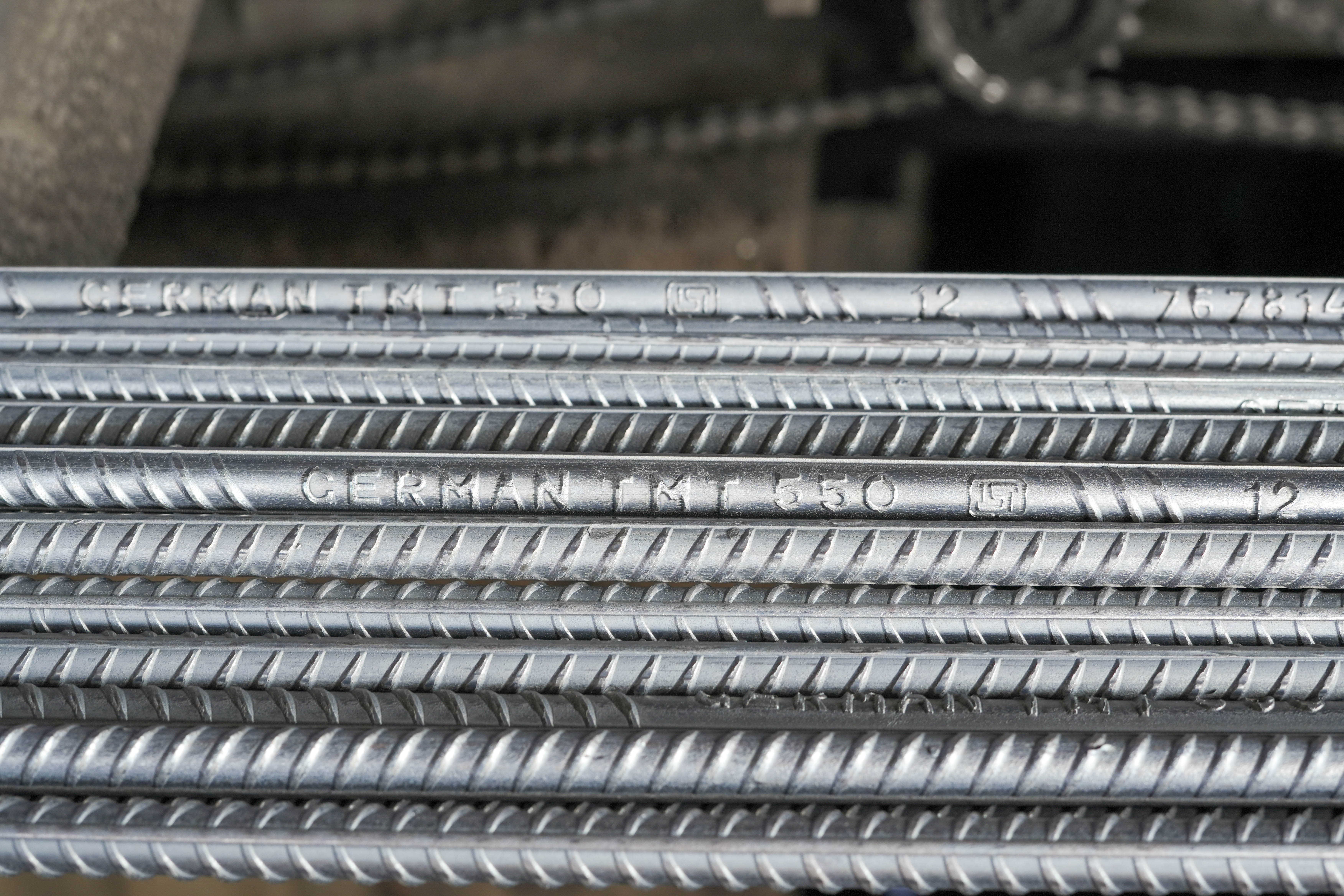
The ribbed surface of a TMT bar creates mechanical interlocking with the surrounding concrete. This helps transfer stresses between the reinforcement and the concrete matrix.
The Bureau of Indian Standards identifies ribbed surface characteristics and bond-related requirements as important aspects of high-strength deformed steel reinforcement under IS 1786.
This is one reason TMT bars are manufactured with defined surface deformation patterns rather than smooth surfaces.
Look closely at a TMT bar and its surface is covered with ribs.
These ribs are not simply a visual feature.
They contribute to the mechanical interaction between reinforcement and concrete.
For reinforcement manufacturers, maintaining appropriate surface characteristics and consistency is therefore an important part of producing TMT bars.
BIS testing information for IS 1786 includes requirements related to deformations and surface characteristics, rib area, and bond strength.
For builders and engineers, this means TMT selection involves more than looking at the grade stamped on the bar.
The physical characteristics of the reinforcement also matter.
A reinforced concrete beam, column, slab or foundation relies on the complementary behaviour of its materials.
Concrete provides compressive resistance.
Steel reinforcement provides tensile resistance.
The bond between them enables forces to be transferred effectively through the composite member.
This is why reinforcement detailing, concrete quality, cover, development length, anchorage and bar characteristics all need to work together.
The TMT bar is one part of a much larger structural system.
When evaluating TMT reinforcement, engineers and procurement teams can consider several characteristics together:
The appropriate balance depends on the project's structural design.
This is why choosing reinforcement should not be reduced to a single specification such as yield strength.
German Steel's approach to TMT manufacturing focuses on controlled production and the mechanical properties required from modern reinforcement.
Its German TMT Bars are manufactured using Thermex Quenching Technology, a controlled quenching and self-tempering process.
The process is designed to produce the combination of strength and ductility expected from TMT reinforcement.
For a detailed explanation of the technology, German Steel's existing Thermex Quenching Technology guide explains how controlled cooling contributes to TMT properties.
A construction project does not use one metre of reinforcement.
It can require hundreds of tonnes across thousands of bars.
That makes consistency an important consideration.
The reinforcement supplied to a project needs to meet the required specifications across production and deliveries.
German Steel's Gujarat-based manufacturing operations support its production of TMT reinforcement, with quality-focused manufacturing processes designed around consistency.
For large construction projects, this can be particularly important because the reinforcement becomes part of foundations, columns, beams, slabs and other structural elements throughout the development.
TMT reinforcement is used across a wide range of reinforced concrete construction.
Foundations transfer structural loads into the ground and rely on appropriately designed reinforcement.
German TMT can be used where the specified grade and reinforcement characteristics meet the project's structural requirements.
Columns carry significant structural loads, making reinforcement detailing and material properties particularly important.
The appropriate TMT grade and reinforcement arrangement should always follow the structural design.
Beams transfer loads through the structure and use reinforcement to resist tensile stresses.
Here again, steel-concrete interaction is an essential part of reinforced concrete behaviour.
Slabs use reinforcement to manage tensile stresses and structural loads according to their design.
Proper reinforcement placement, concrete cover, spacing and detailing work alongside the properties of the TMT bar.
The interaction between steel and concrete ultimately takes place inside the finished structure.
But the characteristics that enable that interaction begin at the manufacturing plant.
Rolling conditions, bar dimensions, rib formation, cooling, metallurgical processing and quality control all contribute to the finished reinforcement.
This is why German Steel's manufacturing infrastructure is an important part of its TMT proposition.
The company combines TMT manufacturing technology with a broader steel manufacturing ecosystem in Gujarat, supporting its ability to produce reinforcement for diverse construction requirements.
Different structures can have different durability requirements.
Where additional corrosion protection is specified for suitable applications, German Steel offers Epoxy Coated TMT Bars.
For projects where corrosion resistance and sustainability are important considerations, CRS Green Steel provides another specialised reinforcement option.
And where reinforcement needs to be supplied in project-specific shapes and dimensions, Cut & Bend Solutions can shift processing into a controlled manufacturing environment.
The result is a broader reinforcement portfolio for India's varied construction requirements.
Even a high-quality TMT bar cannot compensate for poor structural design or incorrect installation.
The performance of reinforced concrete depends on the complete system.
That includes:
The reinforcement manufacturer supplies one critical component of this system.
Structural engineers and construction teams are responsible for ensuring that the reinforcement is designed and installed according to the project's requirements.
Modern Indian construction demands reinforcement that combines multiple characteristics rather than relying on strength alone.
German Steel's TMT manufacturing approach brings together:
Strength
The mechanical capacity required by the specified reinforcement grade.
Ductility
The ability of the steel to undergo deformation as required by its specified grade and application.
Surface characteristics
The ribbed profile required for mechanical interaction with concrete.
Manufacturing consistency
Controlled production supporting consistent reinforcement characteristics.
Technology
Thermex-based controlled quenching and self-tempering.
Product flexibility
TMT, Epoxy Coated TMT, CRS Green Steel and Cut & Bend solutions for different project requirements.
This combination positions German TMT as a reinforcement solution designed around the complete requirements of modern construction.
A TMT bar may appear to be a relatively simple construction material.
Inside a reinforced concrete structure, however, its role is much more significant.
The steel must interact with concrete, transfer forces, accommodate structural demands and perform according to the requirements established by the design.
That makes the manufacturing quality and physical characteristics of reinforcement important considerations for builders and engineers.
German Steel approaches this requirement through its Gujarat-based manufacturing infrastructure, Thermex-based TMT production and broader reinforcement portfolio.
For projects where the right combination of strength, ductility, surface characteristics and manufacturing consistency matters, German TMT provides a reinforcement solution built for modern RCC construction.
The bond allows stresses to be transferred between reinforcement and concrete, enabling the two materials to act together as a reinforced concrete system.
The ribs provide mechanical interlocking with surrounding concrete and contribute to the bond between reinforcement and concrete.
No. Strength needs to be considered alongside ductility, elongation, bendability, weldability where applicable, dimensional consistency, surface characteristics and compliance with the relevant requirements.
German Steel manufactures its TMT Bars using Thermex Quenching Technology, involving controlled quenching and self-tempering.
Yes. Its portfolio includes TMT Bars, Epoxy Coated TMT Bars, CRS Green Steel and Cut & Bend Solutions.
IS 1786 covers high-strength deformed steel bars and wires for concrete reinforcement. BIS materials identify requirements relating to mechanical properties, chemical composition, deformation characteristics, bend performance and bond-related testing.
[ Where we share insights, updates, and stories that matter in the world of construction and beyond. ]
Learn how to store TMT bars correctly at construction sites in Gujarat. Explore practical TMT storage, handling and reinforcement management practices for contractors.

Learn how to select TMT bars for high-rise buildings based on strength, ductility, bendability, bonding, corrosion resistance and project requirements.

.jpg)


.webp)