

How to Store TMT Bars at Construction Sites in Gujarat: A Practical Guide
September 8, 2026
August 16, 2026
Choosing the right TMT bar is one of the most important material decisions in reinforced concrete construction. Whether the project is a residential building, commercial complex, industrial facility, bridge, or major infrastructure development, reinforcement steel has a direct role in the structural performance and durability of the finished structure.
But with numerous TMT manufacturers and grades available in the Indian market, how do you determine which TMT bar is right for your project?
The answer is not simply to look for the highest strength or the lowest price.
A good TMT bar needs to provide the right balance of strength, ductility, bendability, consistency, durability, and manufacturing quality for its intended application.
Before choosing a brand, it is important to understand the parameters that determine TMT bar quality.
A high-quality reinforcement bar should demonstrate appropriate:
These properties work together to determine how reinforcement behaves inside a concrete structure.
This is why choosing a reputable manufacturer with controlled production processes is often more important than simply comparing prices per tonne.
Strength is one of the first specifications buyers look at when comparing TMT bars.
However, structural reinforcement needs more than high tensile or yield strength.
A TMT bar should also have sufficient ductility so that it can undergo deformation under demanding loading conditions rather than behaving as a completely brittle material.
For engineers, the appropriate balance between strength and ductility depends on the structural design, applicable standards, and project requirements.
Different grades of TMT reinforcement are designed to provide different combinations of strength and ductility.
Common grades used in India include:
The appropriate grade should always be selected according to structural design requirements and applicable standards.
For example, higher-strength grades can allow engineers to achieve required reinforcement capacity with different reinforcement arrangements, while ductile grades can be particularly relevant where greater deformation capacity is required.
The objective should therefore be to choose the right grade for the project, rather than automatically choosing the highest grade available.
Ductility describes the ability of steel to deform significantly before failure.
This characteristic becomes particularly important in structures subjected to dynamic or seismic loading, where controlled deformation can be an important part of structural behaviour.
A strong reinforcement bar with appropriate ductility provides engineers with a more balanced material for reinforced concrete construction.
TMT bars are not designed to work independently from concrete.
The reinforcement and concrete need to work together, which makes the interaction between the steel surface and surrounding concrete extremely important.
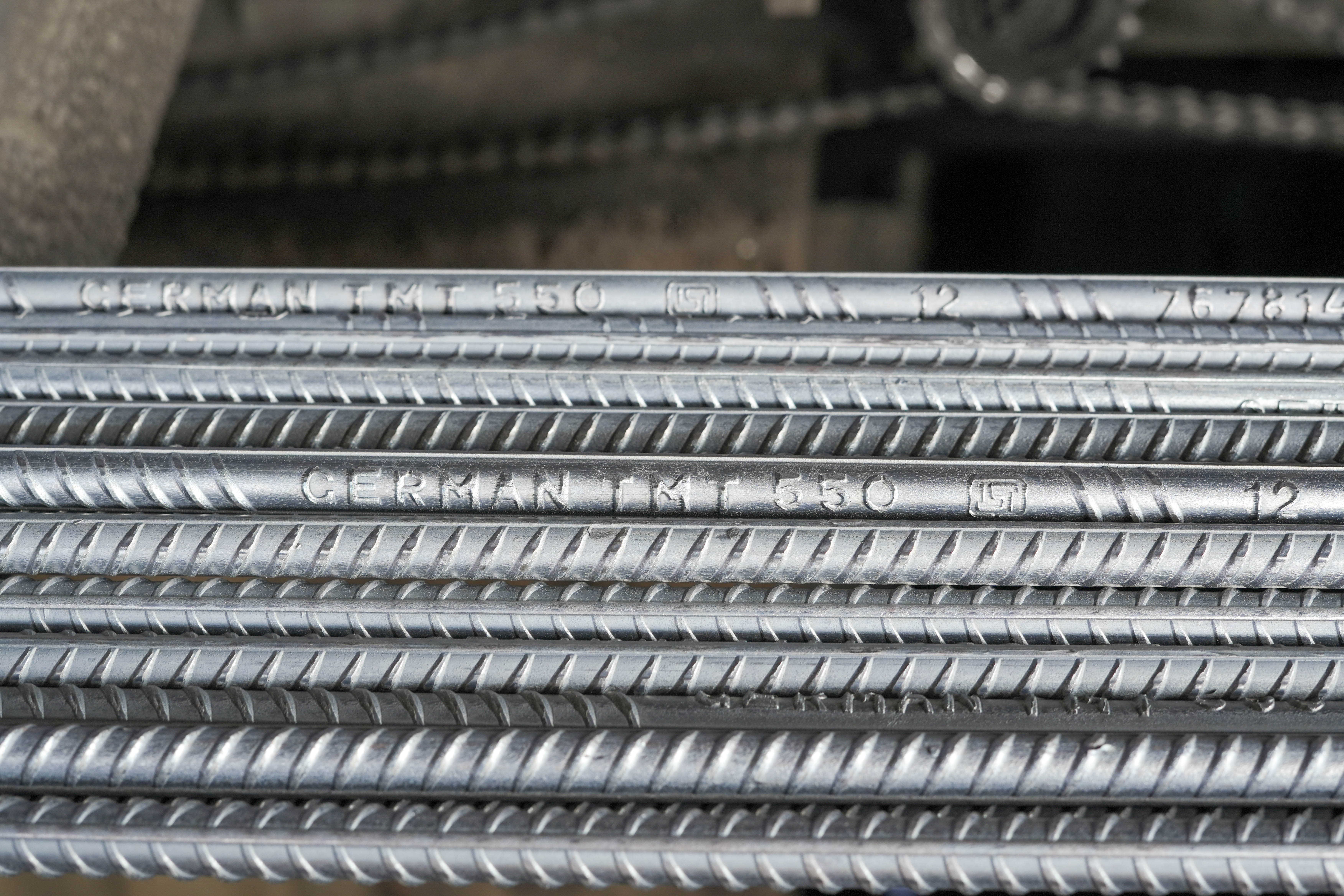
The ribs on a TMT bar help provide mechanical interlocking with concrete.
Consistent rib geometry can therefore contribute to reliable anchorage and load transfer when the reinforcement is properly designed and installed.
The final properties of a TMT bar depend heavily on how it is manufactured.
Modern TMT production involves controlled stages of steel processing, rolling, thermo-mechanical treatment, and cooling.
Consistent control of these processes helps manufacturers achieve predictable mechanical properties and dimensional characteristics.
For large projects using thousands of tonnes of reinforcement, batch-to-batch consistency becomes especially important.
A professional TMT purchase should never be based only on appearance.
Quality verification can involve testing parameters such as:
Buyers should work with manufacturers and suppliers that maintain appropriate quality-control and testing systems and provide documentation required for the project.
The environment in which reinforcement will be used can also influence material selection.
Projects exposed to challenging conditions may require additional corrosion protection.
For such applications, German Steel Epoxy Coated TMT Bars provide an additional protective barrier over the reinforcement and can be considered where corrosion resistance is an important design requirement.
This can be particularly relevant for suitable applications involving:
TMT bar selection is increasingly being considered alongside the environmental impact of steel production.
For developers and organisations with sustainability objectives, understanding how a manufacturer manages energy, water, waste, and emissions can be an important part of supplier evaluation.
German Steel manufactures CRS Green Steel and has invested in initiatives including renewable energy, Waste Heat Recovery Systems, and water management across its manufacturing operations.
This reflects the broader shift towards more responsible steel manufacturing in India.
German Steel brings together several of the factors that matter when selecting reinforcement steel.
With manufacturing operations in Kutch and Samakhiyali, Gujarat, and its head office in Ahmedabad, German Steel produces TMT Bars for residential, commercial, industrial, and infrastructure applications.
Its reinforcement portfolio also includes Epoxy Coated TMT Bars and CRS Green Steel for projects with specific durability and sustainability considerations.
For projects requiring factory-processed reinforcement, its Cut & Bend Solutions can help contractors receive reinforcement prepared according to project requirements.
The result is a broader reinforcement ecosystem rather than a one-product approach.
Price will always matter when purchasing steel, particularly for large construction projects.
However, the cheapest TMT bar is not necessarily the most economical option over the entire project lifecycle.
Buyers should also consider:
A reliable manufacturer can help reduce uncertainty throughout procurement and construction.
Before finalising a TMT manufacturer, builders and procurement teams should ask:
Looking at these factors together gives a much more meaningful picture than comparing only the per-tonne price.
India's construction industry is becoming larger, more sophisticated, and more demanding.
The best reinforcement choice is therefore not necessarily the one with the highest specification or the lowest price. It is the one that matches the project's structural requirements, environmental conditions, quality expectations, and lifecycle objectives.
German Steel's approach combines TMT reinforcement with specialised solutions such as Epoxy Coated TMT Bars, CRS Green Steel, and Cut & Bend services, giving construction teams greater flexibility when selecting reinforcement for different applications.
As India continues to build its next generation of infrastructure, selecting the right steel manufacturer is becoming just as important as selecting the right steel grade.
There is no single TMT grade that is best for every project. The appropriate choice depends on structural design, required mechanical properties, environmental exposure, applicable standards, and project specifications.
Check the required grade, mechanical properties, ductility, dimensional consistency, testing documentation, manufacturing quality, applicable standards, and the manufacturer's ability to reliably supply the required quantity.
Neither is universally better. Fe 500D offers a higher specified ductility requirement than conventional Fe 500, but the appropriate grade should be selected based on the structural engineer's design and project requirements.
Epoxy-coated reinforcement can be considered where additional corrosion protection is required, particularly in suitable moisture-, chloride-, or corrosion-prone environments.
German Steel manufactures TMT Bars and also offers Epoxy Coated TMT Bars, CRS Green Steel, and Cut & Bend Solutions.
German Steel has manufacturing operations in Kutch and Samakhiyali, Gujarat, with its head office in Ahmedabad.
[ Where we share insights, updates, and stories that matter in the world of construction and beyond. ]
Learn how to store TMT bars correctly at construction sites in Gujarat. Explore practical TMT storage, handling and reinforcement management practices for contractors.

Learn how to select TMT bars for high-rise buildings based on strength, ductility, bendability, bonding, corrosion resistance and project requirements.

.jpg)


.webp)