

How to Store TMT Bars at Construction Sites in Gujarat: A Practical Guide
September 8, 2026
May 5, 2026
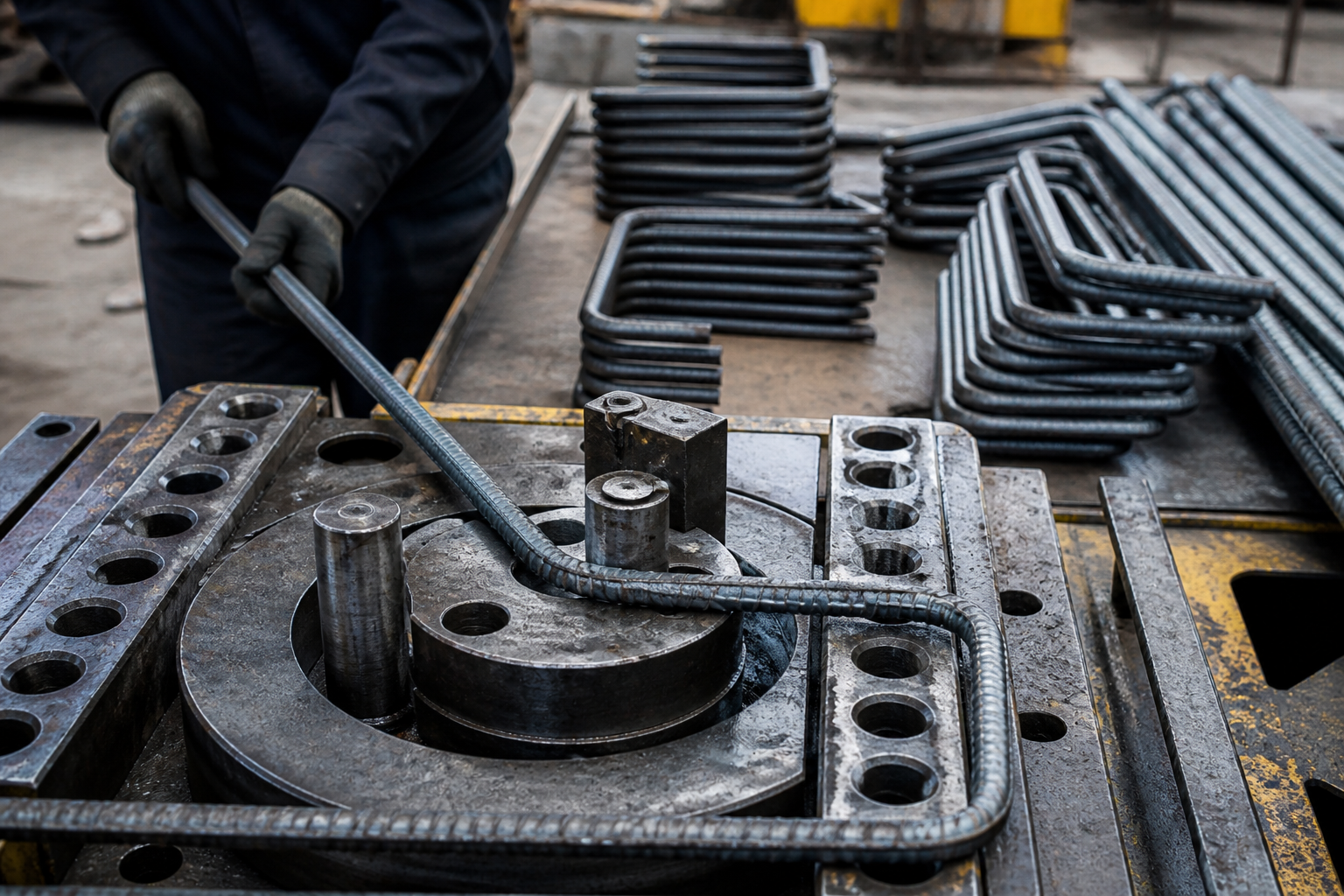
Time and accuracy are vital in today's construction and steel industries. A cut & bend machine for TMT bars has emerged as a game-changer for contractors, builders and steel producers.
Traditional methods of cutting and bending TMT bars are time-consuming and prone to material waste and inaccuracies. Thanks to automation, cut & bend machines are revolutionising the processing of TMT bars, delivering improved productivity, precision and labour efficiency.
A cut & bend machine is a machine that can automatically or semi-automatically cut and bend TMT (Thermo-Mechanically Treated) bars into the desired shapes and sizes for construction.
These are used extensively in:
In building structures, accuracy matters. An error in the length of a bar can have an impact on the strength of a structure.
Today's machines have digital controls and programmable settings to ensure precise TMT bar processing.
Perhaps the most important benefit of a cut & bend machine is the boost in speed.
These machines offer 3-5 times the productivity of manual operation.
Project cost is affected by material wastage. Cut & bend machines help to reduce material wastage.
This results in higher savings and profits.
Cutting and bending by hand involves highly skilled labour.
With a cut & bend machine:
This is particularly advantageous for large construction projects.
Cut & bend machines are used in a variety of industries:
When purchasing a machine, keep in mind:
If you are looking for a reliable solution, you can explore high-quality options here:
Cut & Bend Machine by German Steel: https://germansteel.in/cut-and-bend-machine/
In a world where speedy construction is the need of the hour, automation in construction is a must.
A cut & bend machine helps:
A TMT bar cut & bend machine is a game-changer for the steel and construction industry. It has a high return on investment, delivering better precision, efficiency and cost savings.
Early adopters of the technology have an advantage in meeting project deadlines while maintaining quality standards.
[ Where we share insights, updates, and stories that matter in the world of construction and beyond. ]
Learn how to store TMT bars correctly at construction sites in Gujarat. Explore practical TMT storage, handling and reinforcement management practices for contractors.

Learn how to select TMT bars for high-rise buildings based on strength, ductility, bendability, bonding, corrosion resistance and project requirements.

.jpg)


.webp)